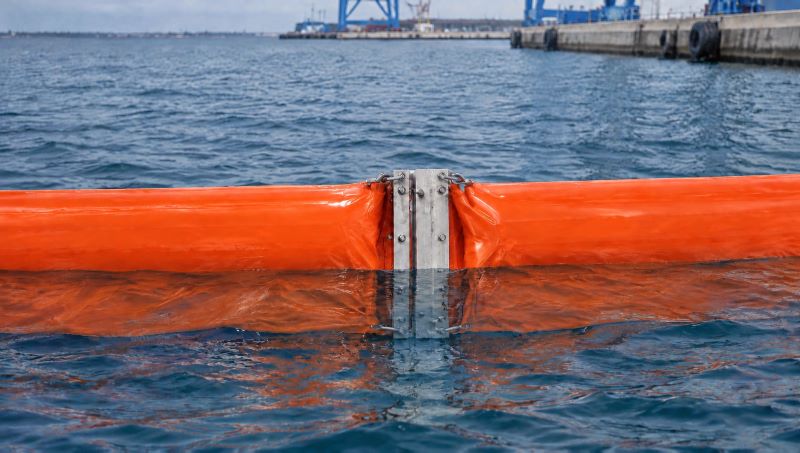
A waterborne spill-control purchase can go wrong before a product ever reaches the water. Buyers may start with a broad search for a “floating curtain,” then compare products that are designed for fundamentally different jobs. A team responding to oil or fuel on the water needs to think about containment, joining, deployment, and recovery. A dredging contractor managing suspended sediment needs a silt-control solution. Treating those products as interchangeable can lead to the wrong specification, the wrong accessories, and an unsuitable deployment plan.
This guide reframes the decision around the WGV750D PVC internal-float oil containment boom from Suzhou Jiahe. It is intended for distributors, marine operators, port authorities, and industrial spill-response teams evaluating a sectional boom for rivers, lakes, oceans, or other possible spill-water areas. It does not present WGV750D as a silt curtain, and it does not add unverified claims about materials, certifications, price, lead time, minimum order quantity, or field performance.
Quick decision: If the project is intended to contain floating oil or another waterborne spill, investigate an oil containment boom. If the primary objective is to manage suspended sediment around dredging or construction, evaluate a silt curtain instead. Confirm the application and final configuration with Jiahe before ordering.
A floating oil containment boom is a floating barrier intended to form a containment line on water. For this article, WGV750D is treated as a PVC internal-float oil containment boom, with its flotation components secured within the boom structure rather than mounted as exposed external floats. Its product information identifies high-frequency welding, high tensile strength, wave-riding, stability, and containment as characteristics. It is listed for river, lake, ocean, and other possible spill-water applications.
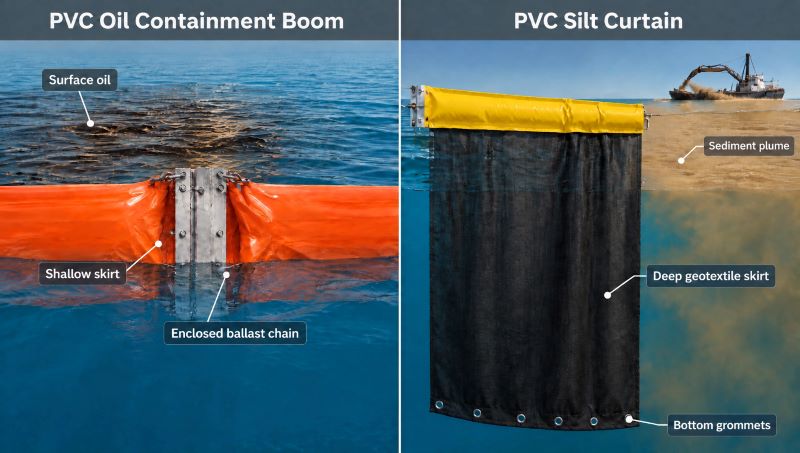
A silt curtain is a different product category used for sediment-control work. It is selected around a sediment-management objective rather than an oil-spill-containment objective. A silt curtain should not be substituted for WGV750D simply because both products can be described informally as floating barriers.
The distinction matters in procurement documents and internal approvals. State the pollutant or material to be managed, the water body, the expected conditions, and the intended deployment layout. Avoid using “silt curtain” as the main product term for WGV750D. If the project is genuinely for sediment control, review a silt-curtain product separately, such as Jiahe’s PVC Silt Curtain - FWP3100, and confirm its suitability with Jiahe.
Before requesting a quotation, answer three questions:
If the answer to the first question is oil or waterborne spill containment, the WGV750D is the relevant product to discuss. If the answer is sediment, do not assume that a boom specification answers the project’s needs.
The most useful starting point is the operating environment. A boom chosen for a sheltered lake may not be appropriate for a river reach with a stronger current, and a configuration considered for a port or ocean location needs a clear review of wave and wind conditions. The WGV750D specification list gives reference values for wave height, wind speed, and flow rate, but those values should not be treated as a universal operating guarantee.
River deployment requires attention to current direction, flow speed, access points, anchoring or positioning plans, and the shape of the containment area. WGV750D lists a flow-rate value of 1.5 kn in its specification table. Use this as a product-page reference only. Confirm with Jiahe how the listed value should be applied to the proposed layout and whether the project requires a different model, configuration, or deployment method.
A distributor or response team should also determine how many sections are needed to create the planned line and how the connections will be handled during deployment. Do not infer section-length availability for a specific model without confirmation: the page lists available lengths of 10 m, 15 m, 20 m, and 30 m, but the mapping between length and model requires confirmation.
A lake project may have fewer current-related constraints than a river, but wind exposure, local wave action, access, and the planned containment geometry still matter. WGV750D is listed with a 0.5 m wave-height value and 10 m/s wind-speed value. These are listed specification values, not a promise that every site with those conditions will perform identically. Confirm the site assessment, selected section configuration, and operating procedure with Jiahe.
The source page lists the product for oceans and other possible spill-water areas. That application statement does not replace project engineering or operational review. Ocean and port environments can vary significantly by location and weather. Confirm whether WGV750D is appropriate for the actual wave, wind, current, traffic, access, and deployment conditions. Ask Jiahe to review the final application rather than assuming the broad application list is approval for every marine scenario.
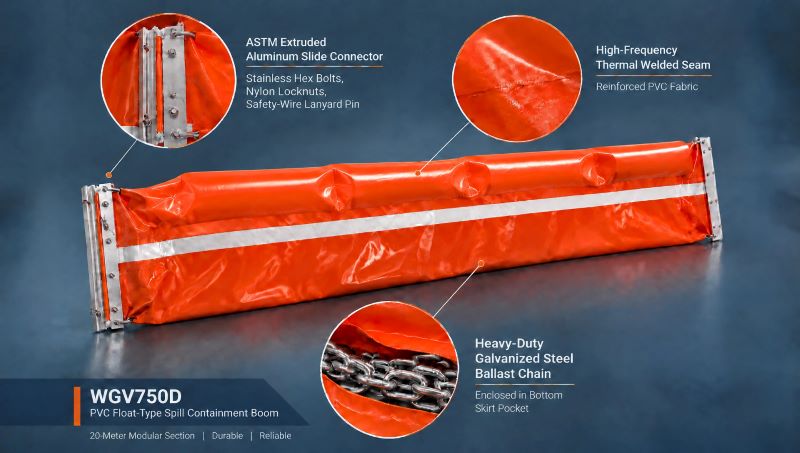
The WGV750D is a sectional PVC internal-float oil containment boom with two listed connection approaches. Its internal flotation arrangement gives the boom a smoother external profile than an exposed-float design, but the final construction and flotation details should be confirmed with Jiahe before ordering. It can be a candidate when a buyer needs a floating containment line and wants to compare the following verified product attributes:
These points support a structured comparison. They do not establish a guaranteed recovery rate, oil-retention percentage, service life, chemical resistance, certification status, or performance in a particular incident. Those items are not asserted here; confirm any requirement with Jiahe.
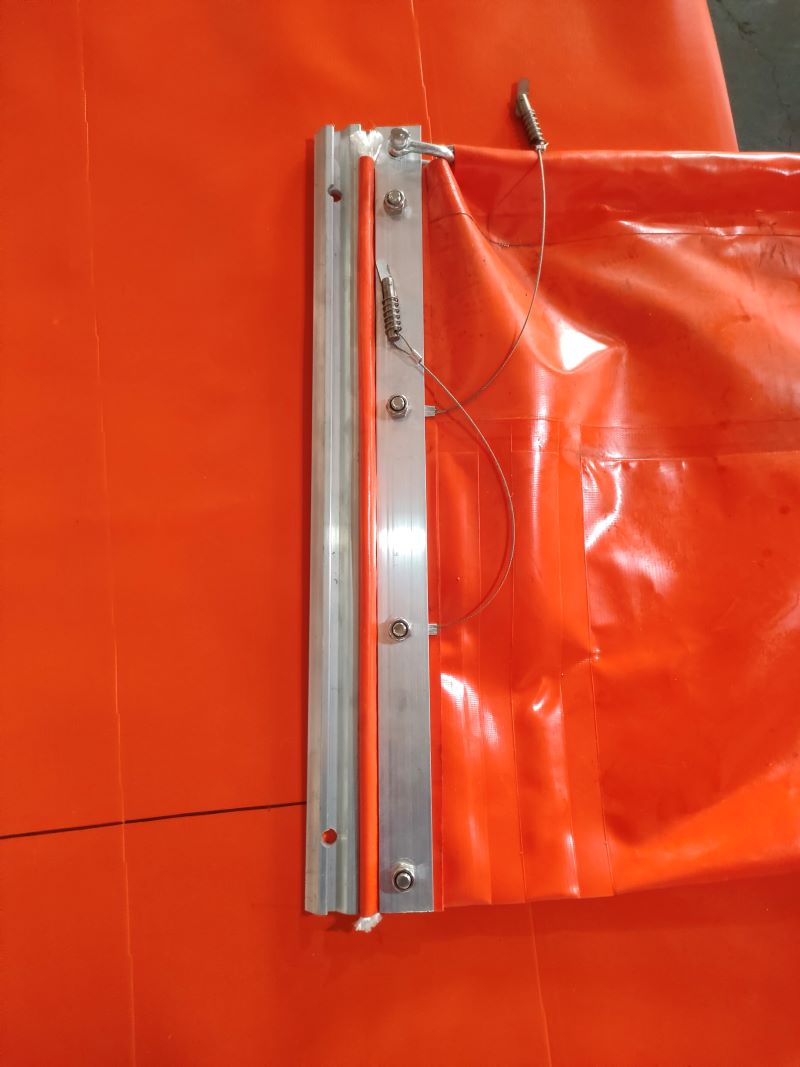
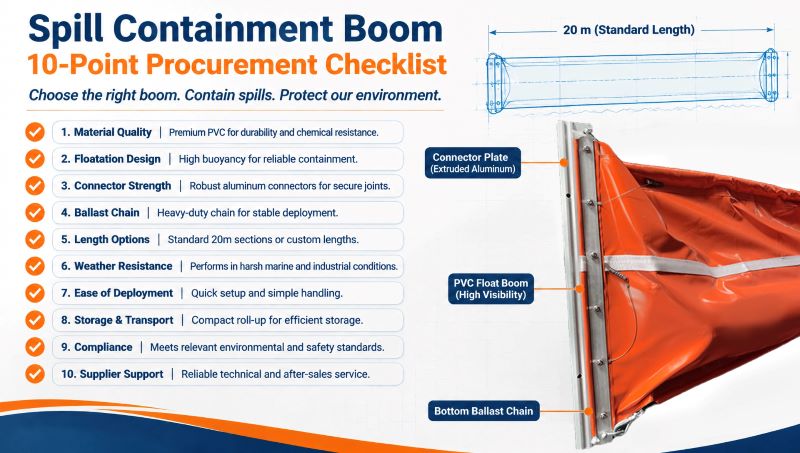
Jiahe lists an ASTM aluminum connection as one option for WGV750D. For a procurement specification, ask Jiahe to confirm the exact supplied connection arrangement, compatible accessories, joining procedure, and any handling requirements for the selected section. The product page confirms the connection option; it does not provide enough information here to define every component or installation step.
The second listed option is a belt + rope + shackle connection. This may be relevant when the buyer’s deployment team uses a belt-and-rope joining approach, but the final configuration must match the project layout and operating procedure. Confirm the supplied components, connection sequence, compatibility, and any site-specific requirements with Jiahe.
Before purchasing, document:
This checklist is deliberately operational rather than promotional. A product specification cannot replace a site plan, and a broad application label cannot confirm suitability for an unreviewed incident.
The following values are transcribed from the supplied WGV750D product information. Confirm the final quotation and configuration with Jiahe.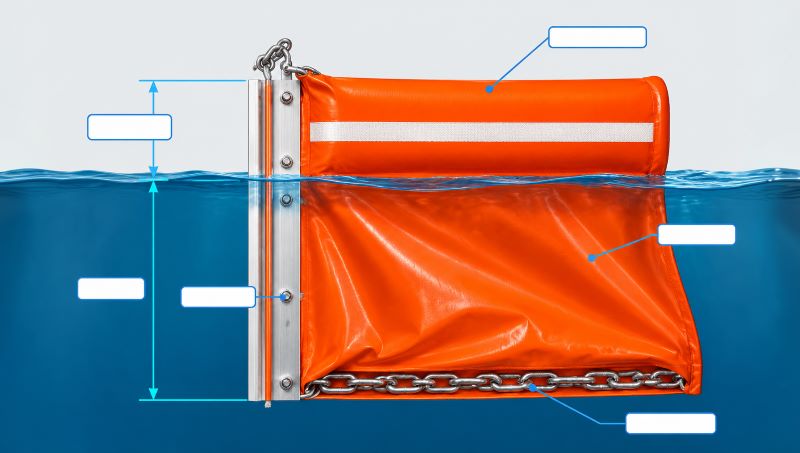
| Parameter | WGV750D listed value | Buyer’s interpretation |
|---|---|---|
| Freeboard | 270 mm | Listed product value; confirm the final configuration. |
| Draft | 380 mm | Listed product value; confirm the final configuration. |
| Tension strength | 40 kN | Listed product value; do not convert it into an unverified site-load guarantee. |
| Wave height | 0.5 m | Listed reference value; compare with actual site conditions. |
| Wind speed | 10 m/s | Listed reference value; confirm how it applies to the planned deployment. |
| Flow rate | 1.5 kn | Listed reference value; review against current, layout, and operating method. |
| Section weight | 60 kg | Listed section value; confirm handling and transport details with Jiahe. |
| Section lengths | 10 m / 15 m / 20 m / 30 m | Availability is listed, but the model-to-length mapping requires confirmation. |
No material thickness, GSM, skirt construction, certification, MOQ, delivery time, price, or performance guarantee is added to this table. Request those details only where they are relevant to your project, and write “confirm with Jiahe” into the purchasing checklist until they are supplied in writing.
The product page contains inconsistent colour references: the URL and page title refer to blue, the page text mentions blue, dark green, and orange, and the supplied images show orange. Therefore, colour must be treated as subject to confirmation. Do not describe blue as an in-stock or standard delivered colour without written confirmation from Jiahe.
The page lists wrapping film as the packing method. Confirm whether the proposed packing is appropriate for your receiving, warehouse, and onward-distribution requirements. Do not infer crate dimensions, palletisation, export packing, or shipping terms from the phrase “wrapping film.”
Suzhou Jiahe’s supplied brand information states 19+ years and identifies ODM/OEM custom logo and packaging support for spill-control products. Distributors and private-label buyers should confirm the available logo and packaging scope, artwork process, approval process, and commercial requirements with Jiahe. This article does not claim a MOQ, lead time, price, or production capacity.
A professional B2B selection guide should make its boundaries clear. WGV750D is listed for waterborne spill-containment applications, but the information reviewed here does not establish that it is suitable for every pollutant, every water velocity, every sea state, every anchoring method, or every emergency-response plan.
Do not use the listed tension strength as a blanket structural approval. Do not treat the listed wave height, wind speed, or flow rate as a guaranteed safe operating envelope. Do not assume the term “oil containment boom” proves compatibility with a particular chemical or fuel. Do not infer a certification, regulatory approval, environmental claim, or measured containment efficiency that is not stated in the verified product information.
For a high-consequence deployment, involve the responsible site and response professionals, define the operating procedure, and obtain the required product and configuration information from Jiahe. The correct conclusion may be a different boom model, another connection arrangement, a silt curtain, or a broader spill-response system. The purpose of this guide is to improve the question being asked—not to replace that review.
The product page lists optional boom cleaning equipment. Buyers should decide before purchase whether cleaning will be part of the operating plan, then confirm equipment availability and compatibility with Jiahe. Ask for the recommended cleaning process for the selected configuration; no unverified chemical, pressure, temperature, or drying instruction is provided here.
A practical maintenance plan should identify who will inspect the boom before deployment, how damage will be recorded, where the sections will be cleaned, and how they will be stored after use. For an internal-float construction, inspect the outer PVC body, welded seams, section connections, and visible flotation integrity; do not open or modify the flotation structure unless Jiahe provides written repair instructions. Confirm the manufacturer’s inspection, cleaning, repair, and storage guidance with Jiahe. Keep records for each section and connection, and do not return a section to service until the responsible team has judged it suitable.
No. WGV750D is treated in this guide as a PVC internal-float oil containment boom. It should not be presented as a silt curtain. If the project is for suspended-sediment control, assess a dedicated silt-curtain product and confirm the choice with Jiahe.
The product information lists rivers, lakes, oceans, and other possible spill-water areas. Confirm suitability for the actual water conditions, spill scenario, and deployment plan with Jiahe.
The page lists an ASTM aluminum connection and a belt + rope + shackle connection. Confirm the exact supplied configuration and joining requirements before ordering.
The listed freeboard is 270 mm and the listed draft is 380 mm. Confirm the final product configuration with Jiahe.
The supplied specification list includes 10 m, 15 m, 20 m, and 30 m. The relationship between each length and the model requires confirmation, so ask Jiahe to state the available WGV750D length in the quotation.
Colour is subject to confirmation. The URL and title reference blue, the text mentions blue, dark green, and orange, and the supplied images show orange. Confirm the delivered colour and any custom-colour option with Jiahe.
Boom cleaning equipment is listed as an optional accessory, not as an automatically included item. Confirm availability, compatibility, and commercial terms with Jiahe.
No. The wave-height, wind-speed, flow-rate, and tension-strength figures are listed product values or reference values. They should be reviewed against the actual site and operating method. Confirm application suitability with Jiahe and the responsible project team.
Send Jiahe a concise enquiry containing:
For distributors: Ask Jiahe for a WGV750D configuration sheet covering section length, connection choice, colour, optional cleaning equipment, and OEM/ODM logo or packaging requirements. Confirm every commercial item directly.
For marine operators and port authorities: Share the water conditions and proposed deployment layout so Jiahe can confirm whether the listed WGV750D configuration fits the application. Do not rely on the broad ocean-use statement alone.
For industrial spill-response teams: Confirm the response objective, handling plan, cleaning plan, and connection workflow before placing an order. Request written product information for any requirement not listed above.
Start with the WGV750D product page, then review Jiahe’s broader Marine Spill Control range. For a sediment-control requirement, compare the dedicated PVC Silt Curtain - FWP3100 rather than treating it as the same product category. Contact Jiahe and write “confirm with Jiahe” beside each unresolved specification before final approval.
Editorial note: This article is a buyer-oriented rewrite based on the supplied Jiahe product page, source blog page, and the user-confirmed internal-float construction. Industry references describe internal or secured flotation as a construction in which the flotation elements are housed within the boom body, but the exact WGV750D flotation material and internal construction should be confirmed with Jiahe. The article avoids unverified claims about materials, thickness, GSM, skirts, certifications, MOQ, delivery, case studies, prices, or guaranteed performance.